
“We put ourselves in a place we don’t belong. Survival is a long shot.” -Dr. Henry Loomis
RATING: 4.5/5
Billed as a “love letter to Steven Spielberg,” and “Jaws meets Jurassic,” director Gareth Edwards (Godzilla, Rogue One) made key decisions to work with 35mm film for the first time, blend special (ex. animatronics, hydraulic lifts, water cannons) and visual effects, and on-location shooting, in the mangroves and Phang Nga Bay (Thailand) and the Mediterranean Sea (Malta). Alongside returning writer, David Koepp (Jurassic Park, The Lost World: Jurassic Park), Edwards delivers a perfect summer blockbuster, full of the wonder, fun, and thrill of the original Spielberg masterpiece.
Screenwriter David Koepp noted: “You can’t tell another story and people go and are surprised by the fact that their lives are in peril – they have to know full well what the risks are and that their lives will be in mortal peril and go anyway.”
Mortal peril is embraced by an expedition aboard a patrol boat, The Essex, chartered by pharmaceutical engineering firm Parker Genix by way of “Martin Krebs” (Rupert Friend). Krebs’ team involves “Zora Bennett” (Scarlett Johansson), “Duncan Kincaid” (Mahershala Ali) and the unsuspecting “Dr. Henry Loomis” (Jonathan Bailey), among others. The crew of The Essex finds itself on a converging path with La Mariposa, a sailboat crossing from Barbados to Cape Town with the Mexican American Delgado family aboard. “Ruben Delgado” (Manuel Garcia-Rulfo), “Teresa Delgado” (Luna Blaise), “Isabella Delgado” (Audrina Miranda), and Teresa’s boyfriend “Xavier Dobbs” (David Iacono), who offers a great deal of comic relief, find themselves unable to object to “Site C.”
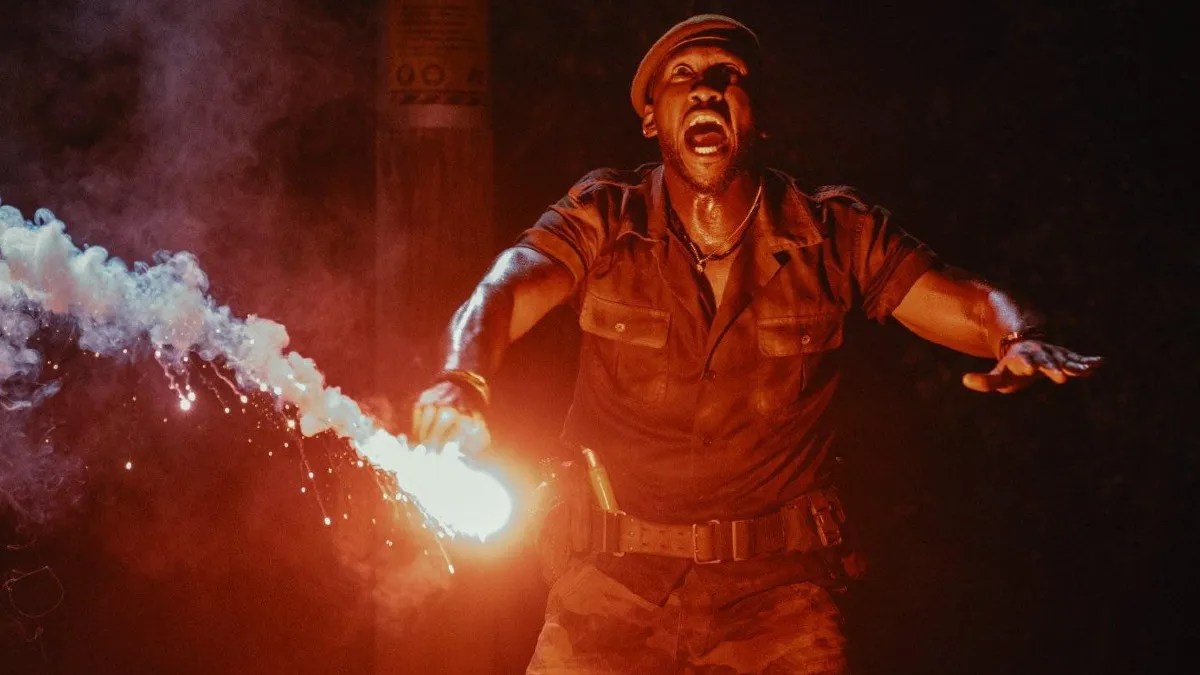
“Being in the mangroves in Thailand…infused a little bit of fear and discomfort in my performance.” -Mahershala Ali, “Duncan Kincaid”
Ile Saint-Hubert, a former InGen property, was known for its research and development efforts where genetic experiments went wrong, resulting in disastrous creations (Distortus rex, or D-rex, and Mutadons, a sort of Pteranodon/Velociraptor hybrid) and the abandonment of the site. Edwards wisely embraces the powers of cloaking, creeping, and camouflaging, in place of overuse – presenting a classical approach to horror.
Prior to the title credits, an ill-fated Snickers wrapper offers a criticism on the rich product placement of the Jurassic World trilogy (2015-2022), specifically validating “Lowery’s” (Jake Johnson) concerns from Jurassic World (2015) when he said: “Why not go the distance, Claire, and just let these corporations name the dinosaurs.” It’s a moment which seemingly signals the end of corporate entanglements, from a visual perspective, allowing the focus to shift to where it belongs – on the creations of the island.
Cinematographer John Mathieson (Gladiator, Gladiator II) necessarily returns the sense of size and scale found in the original Jurassic Park, unobstructed by vehicles in the frame, or buildings nearby. The reason the dinosaurs feel intimidating in Rebirth is because Mathieson collaborated with Edwards to deliver frequent camera movements with eye-levels in the sea (callback to Jaws) and low-angles on land, specifically in the scene with the Titanosaurs. The Titanosaurus present with the same sense of awe the Brachiosaurus did in the original, which is coupled with “Dr. Loomis’” (Bailey) emotional reaction at the sight, observation, and feel of them. His similar excitement at the observed mutualism (interspecies symbiosis) between the newly reimagined Spinosaurus and Mosasaurus makes him a pure delight, and perfect addition to the Jurassic family. I believe Jonathan Bailey’s character as a protégé of “Dr. Grant’s” (Sam Neill).
Similarly, Scarlett Johansson (as “Zora Bennett”) fits well within the expected feminist role of the franchise, as a covert operations expert, who runs point on protection, rescue operations, sample collection, and challenging male authority, a nice nod to the stronger women of the franchise like “Dr. Ellie Sattler” (Laura Dern) and “Dr. Sarah Harding” (Julianne Moore). Johansson doesn’t deliver anything she hasn’t before, but the role was likely written with this depiction in mind and therefore felt tailor-made for her.

“…the raft swept out into the overhanging darkness into brilliant morning sunlight… Grant strained against the oar and, looking over the edge, saw the sheer drop of fifty feet down to the surging pool below. And standing in the pool, waiting for them, was the tyrannosaur…” – Jurassic Park, p. 292
Finally, and perhaps most joyfully, the river sequence, like life, found a way. The Tyrannosaurus rex stalking the Delgado family in the river was a highlight of Jurassic World: Rebirth, just as it was in Michael Crichton’s source material with Dr. Grant, Lex, and Tim. It’s tense from beginning to end and the visuals throughout the moment are a marvel. If I had one singular critique? It’d be for more dinosaurs: I’d have liked to see Spinosaurus show up in a mangrove riverway – I’d have liked to seen Titanosaurus battle Tyrannosaurus or the D-rex – I’d have liked to see Parasaurolophus be hunted – and I’d like to see a variety. Why not have Stegosaurus be a surprise in the forest, or a territorial Triceratops?
What’s next for Jurassic? Could it be rapid evolution driven by stress and isolation (as suggested in 1988’s Digging Dinosaurs, by John R. Horner, who was a basis for the original “Alan Grant” character)? Could it hinge on frog DNA and amphibious characteristics (there are plenty in Jurassic World: Rebirth) that lead dinosaurs back into contact with mankind? Or could it be a closer adaptation of The Lost World: Jurassic Park, Michael Crichton’s second novel.
Whatever comes next, in the words of Dr. Henry Loomis: “Survival is a long shot.” Jurassic World: Rebirth is rated PG-13 and runs 2 hours and 14 minutes.

 BOBBY JAMES