
Rating: 5/5
I should preface this review with the confession that I had no knowledge of the Fantastic Four prior to seeing The Fantastic Four: First Steps. My sole exposure to the property came from professional wrestler CM Punk famously declaring The Thing’s catchphrase: “It’s clobberin’ time,” just after entering an arena to Living Colour’s “Cult of Personality.” This is to say, I went in with a completely open mind and no expectations beyond those I had created for myself, based on the trailer. So it is with absolute confidence that I can certainly say, The Fantastic Four: First Steps could be one of my all-time favorite Marvel movies.
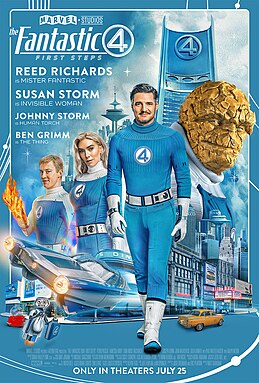
As far as the Marvel Cinematic Universe is concerned, Captain America: The First Avenger (2011) and Captain America: The Winter Soldier (2014) are my favorites, in that order. But something special might have just happened. After nearly fifteen years, countless tie-ins, and the purported “superhero fatigue,” I feel invigorated – and invested in what comes next.
The costume design, by Alexandra Byrne, and production design, by Kasra Farahani, lured me in immediately. Visually, The Fantastic Four: First Steps feels unlike anything Marvel has done previously. It’s been executed flawlessly, and I’d dare say, not having Byrne’s costumes in Oscar contention next year would be an artistic injustice. While period pieces aren’t unfamiliar (ex. WandaVision, Captain America: The First Avenger) in the MCU, The Fantastic Four is set apart by its simultaneous grounding in history and futuristic appeal, which is something the production design gets right.
The movie feels like a throwback to the 1960s, yet it seemingly captures the essence of “the future” at America’s peak obsession with space. To this point, the effects are well done, which is refreshing in an age when CGI, which was innovated decades ago, tends to look cheap. Here, despite the existence of obvious CGI, the practical effects (ex. costume and production design), which are enhanced by the presence of H.E.R.B.I.E./Matthew Wood, a mechatronic prop with a whole lot of soul, focus the film on the cast.

“The Invisible Woman” Sue Storm/Vanessa Kirby, “Mister Fantastic” Reed Richards/Pedro Pascal, “Human Torch” Johnny Storm/Joseph Quinn, and “The Thing” Ben Grimm/Ebon Moss Bachrach are well cast and create a bonded ensemble. I was particularly drawn to Vanessa Kirby’s depiction of “The Invisible Woman,” for she reminded me a lot of Cate Blanchett through her rich vocal delivery, character styling, and emotional range, which added a layer of gravitas to the performance. Her dynamic with Pedro Pascal’s “Mister Fantastic” presents an undeniable spark that believes these characters as a couple. And while “The Invisible Woman” is paired with “Mister Fantastic” regularly for emotionally impactful moments, the relief comes from the fun dynamic between Joseph Quinn’s “Johnny Storm” and Ebon Moss Bachrach’s “The Thing.”
The primary cast presents the impression of a dynamic family, complete with their own motivations and moments. These moments, some fleeting, offer each character depth through interactions with the likes of “The Silver Surfer” Shalla-Bal/Julia Garner, Rachel Rozman/Natasha Lyonne, and “The Mole Man” Harvey Elder/Paul Walter Hauser. This subtlety is owed to the direction of Matt Shakman, the masterful score of Michael Giacchino (who I consider the greatest composer working), and the screenplay by Josh Friedman, Eric Pearson, Jeff Kaplan, and Ian Springer.
In lesser hands, or with the wrong players, The Fantastic Four: First Steps could have easily become another “heroes have to defend the earth from a space invader” movie. Instead, it’s something much more heartfelt. It’s a balancing act of superhero movie, family drama, and science fiction, featuring a world-eating villain named Galactus/Ralph Ineson.
Simply put, The Fantastic Four: First Steps is a … fantastic movie.
The Fantastic Four: First Steps is in theaters everywhere and is rated PG-13 for mild violence and profanity. The film runs 1 hour and 55 minutes; features a mid-credits scene and a post-credits scene.

 BOBBY JAMES